
Panic Attack While Speaking: The HEART Protocol
You’re standing in front of the room. Your heart is pounding. Your mind goes blank. You tremble uncontrollably. You can’t catch your breath. You can’t get your point across. A sense of unreality closes in. You want to run and escape.
This isn’t just nervousness—this is a full-blown panic attack during public speaking. And if you’ve experienced it, you know the terror is real. The fear that it will happen again can become so powerful that you’ll do almost anything to avoid speaking situations altogether.
But here’s the good news: panic attacks while speaking are preventable, manageable, and can be permanently overcome with the right protocol.
The MAP System and the HEART Protocol were developed by Dr. Cheryl Mathews (Psy.D.) specifically to address public speaking anxiety and panic.
Key Takeaways
- Panic attacks while speaking follow a predictable pattern that can be interrupted
- The HEART Protocol provides a step-by-step method to stay on the “normal anxiety curve” and prevent panic escalation
- HEART stands for: Head Off The Spiral, Eye On The Ball, Allow First Fear, Ride the Wave, Take the Win
- Each step is grounded in proven psychological research on exposure therapy, cognitive restructuring, and mindfulness.
- The protocol works best when practiced in safe environments before high-stakes situations
Understanding the Panic Spiral: Why It Happens
A panic attack isn’t just “really bad anxiety.” It’s a specific physiological response where your body’s alarm system goes into overdrive. Your amygdala (the brain’s fear center) detects what it perceives as danger and floods your system with stress hormones—adrenaline (epinephrine), cortisol, and noradrenaline (norepinephrine). These chemicals are intended to make you more alert and give you extra energy so you can respond to a physical danger.
The problem? There’s no actual danger. You’re not being chased by a predator. You’re giving a presentation, asking a question in a meeting, or introducing yourself to a group. But your brain doesn’t know the difference between a physical threat and a social threat.
Once the panic spiral begins, it follows a predictable pattern:
- Initial trigger: You notice physical symptoms (increased heart rate, sweating, trembling)
- Catastrophic interpretation: You think “Something is wrong! I’m going to panic! Everyone will see!”
- Symptom amplification: The fear of the symptoms makes them worse
- Escape urge: Your brain screams “GET OUT NOW!”
- Memory reinforcement: If you escape, your brain learns “speaking = danger,” making future panic more likely
Here’s what makes it worse: Most advice tells you to “just push through” or “face your fears.” But without the right tools, flooding yourself with overwhelming anxiety doesn’t desensitize you—it traumatizes you. Each panic experience strengthens the fear pathway in your brain, making the next speaking situation even more terrifying.
The Two Curves: Normal Anxiety vs. Panic
Imagine your anxiety on a graph with time on the horizontal axis and intensity on the vertical axis. There are two very different patterns your anxiety can follow:
📈 The Normal Anxiety Curve
↗️⬇️
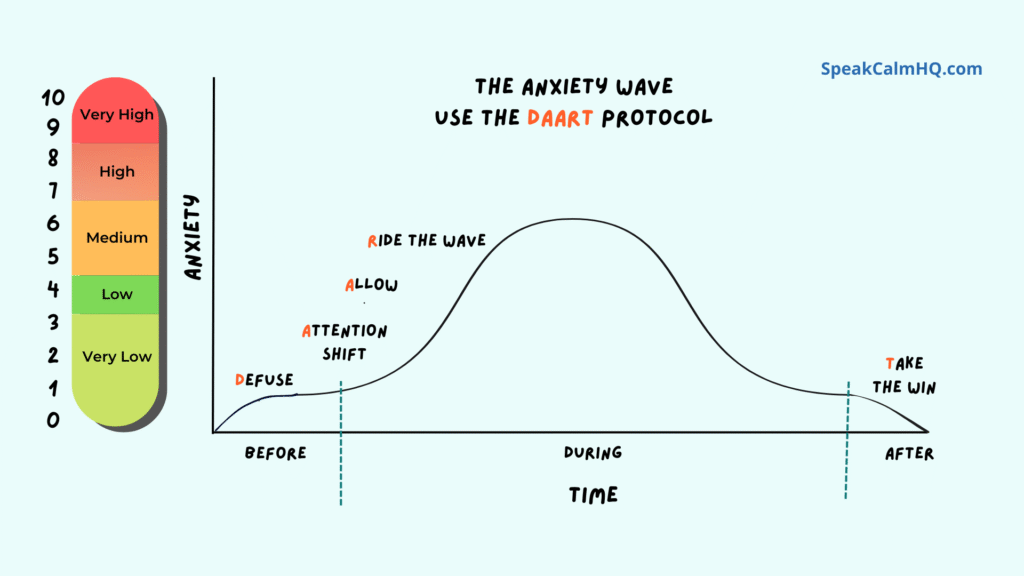
Gentle wave pattern
- Anxiety rises. When you first start exposures, it will rise higher, but keep practicing and the anxiety will peak at more moderate levels over time. That’s why safe practice groups are important.
- Over time, peaks at manageable levels (4-6 range). For very high-stakes situations it may peak at 7-8 but with practice it will go down pretty quickly
- Naturally subsides on its own
- You can function throughout
- Builds positive memory database
⚡ The Panic Curve
↗️
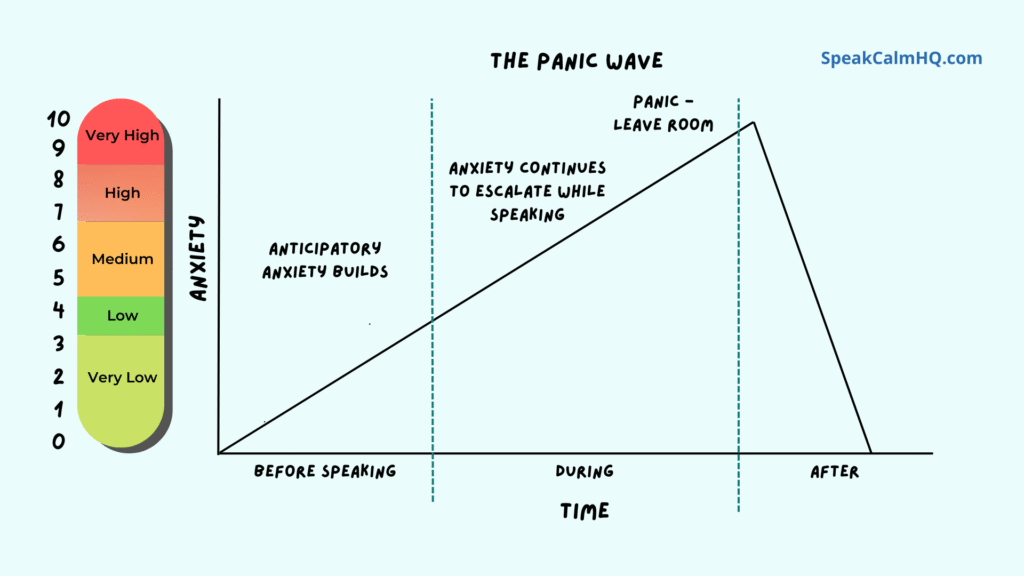
Sharp spike pattern
- Anxiety escalates rapidly
- Shoots to 8-10 intensity
- The intensity is often surprising and unexpected
- You feel out of control
- Reinforces trauma memory
The goal of the HEART Protocol is simple: keep you on the normal anxiety curve and prevent the panic spike from silencing our voice.
Introducing HEART: Your Five-Step Defense Against Panic
HEART is a tactical response system designed specifically for managing panic and escalating anxiety during public speaking. Unlike generic relaxation techniques, each step of HEART targets a specific mechanism in the panic cycle.
Step 1: Head Off Second Fear
What it is: Catching and neutralizing catastrophic thoughts before they trigger the panic cascade.
When to use it: At the first contact with anxiety—this could be weeks before your speaking event, days before, and the moment you step up to speak.
How it works: Your brain is running frightening “what if” scenarios like horror movies in your head:
- “What if I freeze and can’t speak?”
- “What if I have a panic attack in front of everyone?”
- “What if my mind goes completely blank?”
- “What if everyone sees how nervous I am and judges me?”
This is what psychologists call “second fear”—the fear of the fear itself. You’re scaring yourself with imagined catastrophes that haven’t happened and don’t have to happen. But here’s the catch: if you dwell on these thoughts, they become self-fulfilling prophecies. Your nervous system responds to your imagination as if the threat were real.
Your new script:
- “Just because something happened in the past doesn’t mean it has to happen now.”
- “I’ve been practicing and building new positive memories—that changes how my nervous system responds.”
- “I’ve done this before successfully.” This works once you get more practice in safe groups and build positive memories!
- “My anxiety is information, not danger.”
- “I have tools to manage this.”
Research foundation: This is cognitive reframing, a cornerstone of Cognitive Behavioral Therapy (CBT). Studies show that challenging catastrophic thoughts reduces physiological arousal and prevents anxiety escalation.
Step 2: Eye On The Ball
What it is: Redirecting your focus from internal symptoms to external targets.
When to use it: As soon as you notice you’re monitoring your symptoms (heartbeat, shakiness, breath, blushing).
How it works: Panic thrives on self-monitoring. When you’re hyper-focused on your racing heart or shaky hands, you’re essentially telling your amygdala, “Pay attention to this! This is important! This might be dangerous!” Your brain responds by amplifying the symptoms.
Where to shift your attention:
- To your message: What information do you want to share? What does your audience need to know?
- To your environment: Notice details in the room—the clock on the wall, the color of the chairs, the pattern on the carpet
- To your audience: Find a friendly face. Notice someone nodding. Look for signs of interest
- To physical objects: Hold note cards, touch the podium, feel your feet on the ground
Why this is powerful: Psychological research shows that present-oriented, external focus significantly reduces performance anxiety. Your brain can’t simultaneously monitor internal symptoms AND process external information effectively. By deliberately shifting attention outward, you interrupt the panic spiral.
Research foundation: Attentional control is a key component of anxiety management. Studies show that directing attention away from threat cues (including internal sensations) reduces both subjective anxiety and physiological arousal. There is a large body of research in the field of anxiety and attention control and you may want to start with David M. Clark at the University of Oxford and Matt Abrahams at Stanford University.
Step 3: Allow
What it is: Accepting First Fear – the first manageable wave of anxiety without fighting it or trying to suppress it.
When to use it: When you notice the first signs of symptoms and your instinct is to fight it, push it down, or make it stop. When you say to yourself “Oh no, this is bad. My anxiety is going to escalate our of control. This should not be happening.”
How it works: Here’s the counterintuitive truth—resistance amplifies panic. When you fight First Fear, you’re sending your amygdala the message: “This IS dangerous! We need to fight this!” Your nervous system responds by flooding you with even more stress hormones. In reality, First Fear is what the average person experiences when they start to speak. It’s normal and to be expected. You can function with First Fear.
Acceptance does the opposite. When you allow First Fear to be there, you’re essentially telling your nervous system: “This is temporary. This is uncomfortable but not dangerous. I can handle this.”
What allowing looks like:
- “Okay, First Fear, you can be here. You’re not going to hurt me.”
- “I feel my heart racing, and that’s okay. It will pass. The more I don’t resist it, the faster it will pass.”
- “My hands are shaking. That’s just my body responding. That will pass quickly and nothing is wrong.”
- “I can speak with anxiety present. I don’t need it to go away first.”
Research foundation: This is Acceptance and Commitment Therapy (ACT) in action. Dozens of studies show that acceptance-based strategies are more effective than suppression for managing anxiety. Paradoxically, when you stop trying to control anxiety, it loses its power.
Step 4: Ride the Wave
What it is: Staying in the situation long enough for anxiety to naturally peak and then decrease.
When to use it: Throughout your speaking situation, especially when you feel the urge to escape.
How it works: Anxiety follows a predictable pattern—it rises, peaks, and falls. Always. Your body physically cannot maintain peak anxiety indefinitely. It’s biologically impossible. The stress hormones get metabolized, your nervous system regulates, and the intensity decreases. This can happen pretty quickly as long as you don’t flood your body with stress hormones.
But here’s the crucial part: You must stay in the situation long enough to experience the downward slope of the curve. If you escape during the peak, your brain learns “I survived by escaping!” and the next time you face a speaking situation, the anxiety will be even stronger.
Think of it like floating over a small manageable wave on an air mattress—you don’t fight the wave, and you don’t jump off the mattress. You stay on, maintain your balance, and ride it until the wave quickly goes up and down. It naturally subsides on it’s own.
Why escape sabotages you: Every time you avoid or escape a speaking situation, you reinforce the neural pathway that says “speaking = danger.” This is called negative reinforcement, and it’s incredibly powerful. Your brain remembers: “I felt terrible, I left, I felt better—therefore leaving saved me.” This makes the next speaking situation exponentially more frightening.
Research foundation: This is the core of exposure therapy, one of the most well-researched treatments for anxiety. Studies show that habituation (the natural decrease in anxiety over time) only occurs when you stay in the feared situation long enough for your nervous system to learn it’s safe.
Step 5: Take the Win
What it is: Deliberately recognizing and celebrating your success, no matter how small.
When to use it: Immediately after your speaking experience—within minutes if possible.
How it works: Your brain has a negativity bias, especially when it comes to anxiety-provoking situations. After you speak, your anxious brain will want to focus on everything that went “wrong”:
- “I stumbled over that word”
- “I could feel myself shaking”
- “I forgot one of my points”
But here’s what’s actually true: You did it. You faced your fear. You stayed in the situation. You communicated your message. You didn’t let the anxiety win.
That is success. And your brain desperately needs to encode this as a win to start rewriting the fear memory.
How to take the win:
- Say it out loud: “I did it. I spoke despite the anxiety.”
- Write it down immediately: “Today I accomplished [specific action]. I felt anxious and I did it anyway.”
- Tell someone supportive: “I faced my fear today.”
- Rate your success based on YOUR goal, not perfection: “My goal was to share one key point, and I did that. The goal was not to be perfectly calm or to give a perfect delivery. My goal was get my key point across—even imperfectly with some anxiety.”
Research foundation: Memory reconsolidation research shows that the immediate period after an experience is critical for how that memory is encoded. By deliberately framing the experience as a success, you’re literally changing the neural pathway from “trauma” to “success.” Over time, these wins accumulate, and your brain learns: “I can handle this.”
Why HEART Works When Other Methods Fail
Most public speaking advice falls into one of two camps:
Camp 1: “Just push through”
This advice ignores the reality of panic. Forcing yourself into overwhelming situations without tools doesn’t build confidence—it builds trauma. Each panic experience strengthens the fear pathway.
Camp 2: “Breathe deeply and think positive”
Generic relaxation techniques and positive affirmations can help with mild nervousness, but they’re not enough for panic. You need a comprehensive protocol that addresses both the cognitive and physiological components of anxiety.
HEART works because it’s based on 60+ years of psychological research on exposure therapy, cognitive restructuring, acceptance-based interventions, and memory reconsolidation. Each step targets a specific mechanism in the panic cycle. It’s not motivational fluff—it’s a science-backed protocol for rewiring your fear response.
Putting HEART Into Practice: Your Action Plan
🎯 Start Where You Are
Step 1: Learn the protocol
Understand each step of HEART. Know why each step works. This isn’t just memorization—understanding the science builds confidence.
Step 2: Practice in safe environments first
Don’t wait for high-stakes situations to try HEART. Practice in low-pressure settings like:
- SpeakCalmHQ Practice Clubs (designed specifically for anxiety management)
- Small group conversations
- Video recordings
- Virtual meetings with cameras off initially and work up to turning your camera on and doing progressively more challenging exercises
Step 3: Build your positive memory database
Every successful speaking experience—no matter how small—rewires your brain. Aim for consistency over intensity. Three 5-minute practice sessions where you use HEART successfully are worth more than one 30-minute presentation where you panic.
Step 4: Track your progress
Keep a simple log:
- Date and speaking situation
- Anxiety level before (1-10)
- Peak anxiety during (1-10)
- Anxiety at the end (1-10)
- Which HEART steps you used
- Your win (what you accomplished)
Over time, you’ll see patterns. You’ll notice your baseline anxiety decreasing. You’ll see that you’re capable of more than you thought.
The Bottom Line: You Can Overcome Panic
Panic attacks while speaking feel overwhelming, terrifying, and permanent. But they’re not. With the right protocol, safe practice, and consistent application, you can retrain your nervous system to respond to speaking situations with manageable anxiety instead of panic.
The HEART Protocol gives you a step-by-step method to:
- Catch catastrophic thoughts before they spiral (Head Off Second Fear)
- Redirect attention away from symptoms and threat cues (Eye On The Ball)
- Stop fighting First Fear and let it be (Allow)
- Stay present until the wave naturally subsides (Ride the Wave)
- Rewire your fear memory with wins (Take the Win)
This isn’t about becoming fearless. It’s about learning to function with fear present. It’s about staying on the normal anxiety curve instead of spiking into panic. It’s about building a new database of positive memories that prove to your brain: “I can do this.”
Remember: Every person who has panicked and speaks confidently today once felt the way you do now. The difference isn’t that they’re naturally brave or that their anxiety magically disappeared. The difference is they learned how to manage their nervous system. And you can too.
Start with one HEART step today. Notice your catastrophic thoughts and practice defusing them. In your next speaking situation—even if it’s just answering a question in a virtual meeting—use Eye On The Ball. Build slowly. Celebrate every win.
You’re not broken. You’re not alone. And with the right tools, you absolutely can overcome panic while speaking.