
Public Speaking Anxiety: Complete Guide
Public Speaking Anxiety: Complete Guide
If your heart races, your mind goes blank, or you avoid speaking opportunities altogether—you’re not alone. Public speaking anxiety affects millions of people, ranging from mild nervousness to full-blown panic attacks. But here’s the truth if you have high-to-severe anxiety: you’re not broken, and with the right approach, you can transform your relationship with public speaking.
What You’ll Learn in This Guide
- What public speaking anxiety really is (and why “imagine the audience naked” or “just relax” doesn’t work)
- The MAP System: A science-backed framework for managing anxiety
- The HEART Protocol: Your tactical response system for panic moments
- Why traditional advice fails and what actually works
- How to practice smart without overwhelming yourself
- Measurable steps toward more confident communication
Understanding Public Speaking Anxiety
Public speaking anxiety isn’t just “butterflies in your stomach.” For many people, it’s a severe, debilitating condition that can include:
- Panic attacks before or during speaking
- Mind going completely blank
- Physical symptoms: shaking, sweating, rapid heartbeat, nausea
- Avoiding opportunities for career advancement
- Declining social invitations where speaking might be required
- Can’t enjoy your evenings and weekends before a presentation
The Anxiety Spectrum: Anxiety exists on a continuum from 1-10. At levels 1-6, you can still function and communicate effectively—even if you feel uncomfortable. At levels 9-10, you’re in panic territory where speaking becomes nearly impossible. The goal isn’t to eliminate all nervousness; it’s to keep anxiety in the manageable 4-6 range where you can communicate effectively.
Why You’re Not Broken
If your anxiety spikes when speaking, your brain and body aren’t malfunctioning—they’re responding to what they perceive as danger. Your amygdala (the brain’s fear center) has learned to associate public speaking with threat, triggering your body’s alert system to flood you with stress chemicals.
This response can be retrained. Your brain is capable of building new, positive associations with speaking situations through systematic exposure and the right techniques.
Why Traditional Advice Fails
You’ve probably heard the standard recommendations:
❌ What Doesn’t Work
- “Just relax”
- “Picture everyone naked”
- “Face your fears head-on”
- “Fake it till you make it”
- “You just need more confidence”
- Toastmasters or other performance-focused groups (that don’t specialize in systematic exposure and desensitization)
✅ What Actually Works
- Understanding first fear as manageable
- Strategic activation control
- Gradual, safe exposure
- Building positive memory databases
- Reframing success realistically
- Anxiety-specific practice environments
The Flooding Problem: Being forced into high-pressure speaking situations before you’re ready doesn’t build confidence—it reinforces trauma. Each panic experience creates another negative memory, strengthening your brain’s association between speaking and danger. This is why “sink or swim” approaches often make anxiety worse, not better.
The MAP System: Your Science-Backed Solution
The SpeakCalmHQ MAP System is a comprehensive framework created by Dr. Cheryl Mathews, Psy.D., leveraging over 60 years of research in social anxiety, panic, cognitive-behavioral therapy, and systematic exposure and desensitization.
MAP stands for:
M = Mindset Shifts
A = Activation Control
P = Practice Smart
The Three Pillars Explained
M = Mindset Shifts (Foundational)
Your internal beliefs and dialogue profoundly shape your anxiety experience. The MAP System guides you through five essential mindset reframes:
1. Reframe Anxiety: Normal, manageable anxiety (1-6) is not only acceptable—you can speak effectively with it. The goal is to prevent escalation to panic (9-10), not eliminate all nervousness.
2. Reframe Success: Success means achieving your communication goal, not feeling perfectly calm or delivering a flawless performance. If your goal is to present quarterly results and you do so—even with shaky hands—that’s success.
3. Reframe the Audience: Most audiences are friendly, neutral, or preoccupied with their own concerns—not hostile critics waiting for you to fail. They want useful information delivered so they can understand your key point.
4. Reframe the Situation: Speaking is a conversation and information exchange, not a life-or-death performance. Perfection isn’t required or expected. Focus on: “What does my audience need to know?” rather than “How do I appear?”
5. Reframe Yourself: You’re not defective or fundamentally incapable. Your brain has learned an unhelpful pattern that can be changed with proper tools and support.
A = Activation Control (Tactical)
When alert chemicals (stress hormones) flood your system, you need immediate techniques to manage symptoms and keep anxiety in the manageable range. Activation Control operates on two tracks:
Mental Control:
- Recognizing danger messages and catastrophic thinking
- Disputing cognitive distortions
- Developing observer mind perspective
- Sending your amygdala “all clear” signals through calming self-talk
Body Control:
- Strategic breathing techniques
- Progressive muscle relaxation (PMR)
- Physiological interventions to calm the nervous system
- Understanding that moderate alert chemicals aren’t dangerous
Integrated Response: HEART Protocol (explained in detail below)
P = Practice Smart (Application)
Practice only works when it’s the right kind of practice:
- Safe Exposure: Practice in anxiety-specific environments, not high-pressure situations
- Positive Memory Database: Start with manageable challenges and repeat until your brain builds new, non-threatening associations
- Avoid Flooding: Never overwhelm yourself—progress gradually with consistent, non-traumatizing steps
- Accurate Feedback: Discover how little anxiety is actually visible to others and focus on clear communication, not symptom control
- 3-5 Times Weekly: Regular practice during your first year creates lasting neural changes
- 50+ Experiences: Building a robust database of positive speaking memories rewires your fear response
“You’re not alone, and with the right techniques and support, you can break the cycle and rebuild your confidence.” – Dr. Cheryl Mathews
The HEART Protocol: Your Tactical Response System
HEART is your real-time playbook for managing anxiety and preventing panic escalation. It integrates both mental and body control in the heat of the moment, living within the Activation Control pillar of the MAP System.
HEART stands for:
Head Off The Spiral
Eye On The Ball
Allow First Fear
Ride the Wave
Take the Win
Understanding the Two Anxiety Curves
Before learning HEART, you need to understand how anxiety can follow two very different patterns:
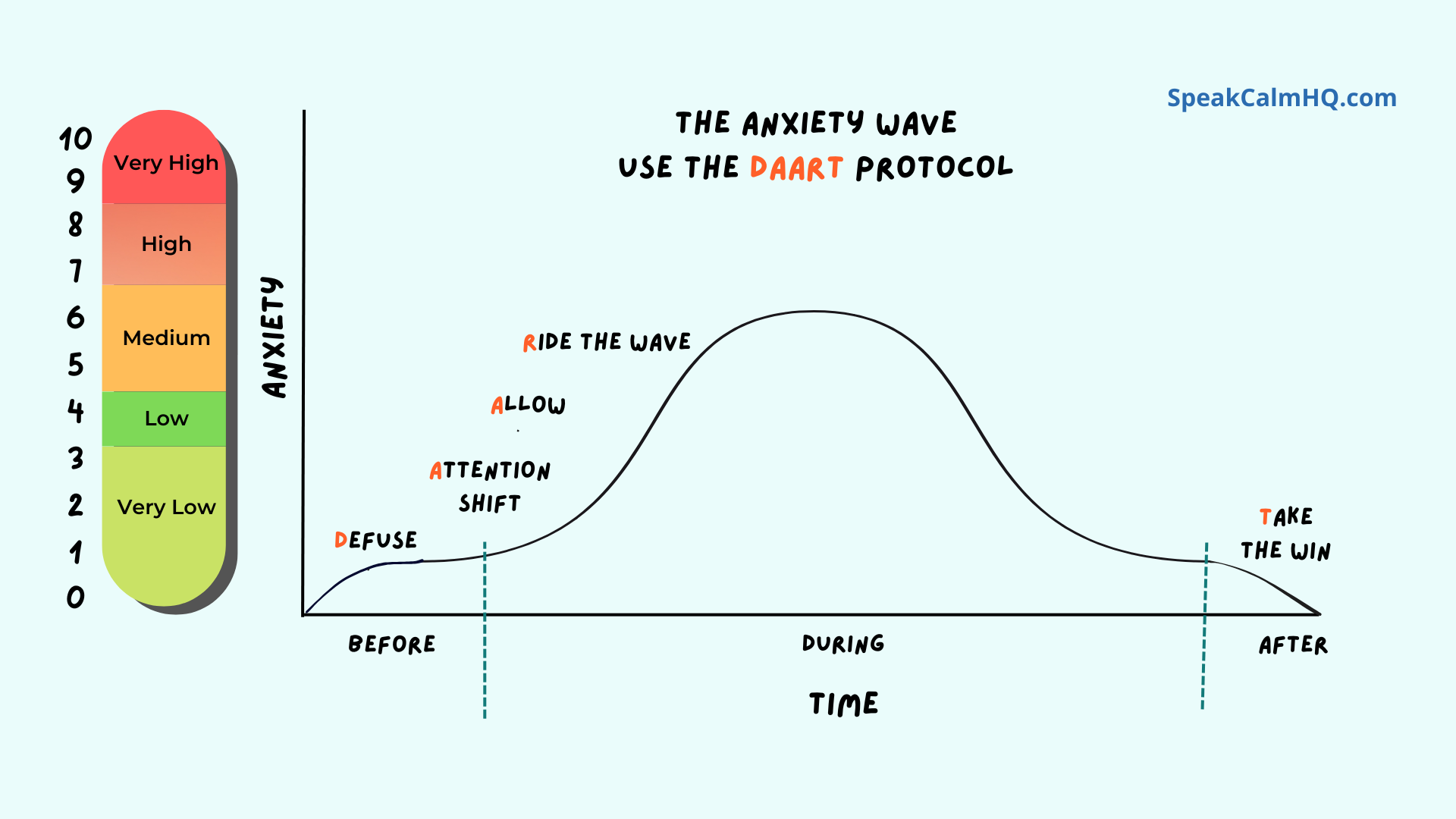
🟢 The Normal Anxiety Curve
A gentle wave where anxiety rises slightly, peaks at a manageable level (typically peaks 4-6; may peak 7-8 in high-stakes situations), then fairly quickly naturally subsides. This is optimal for speaking and learning.
🔴 The Panic Curve
A sharp spike where anxiety escalates rapidly to 9-10 and doesn’t come down until you leave the situation. It’s intense and feels uncontrollable.This reinforces trauma and strengthens fear associations.
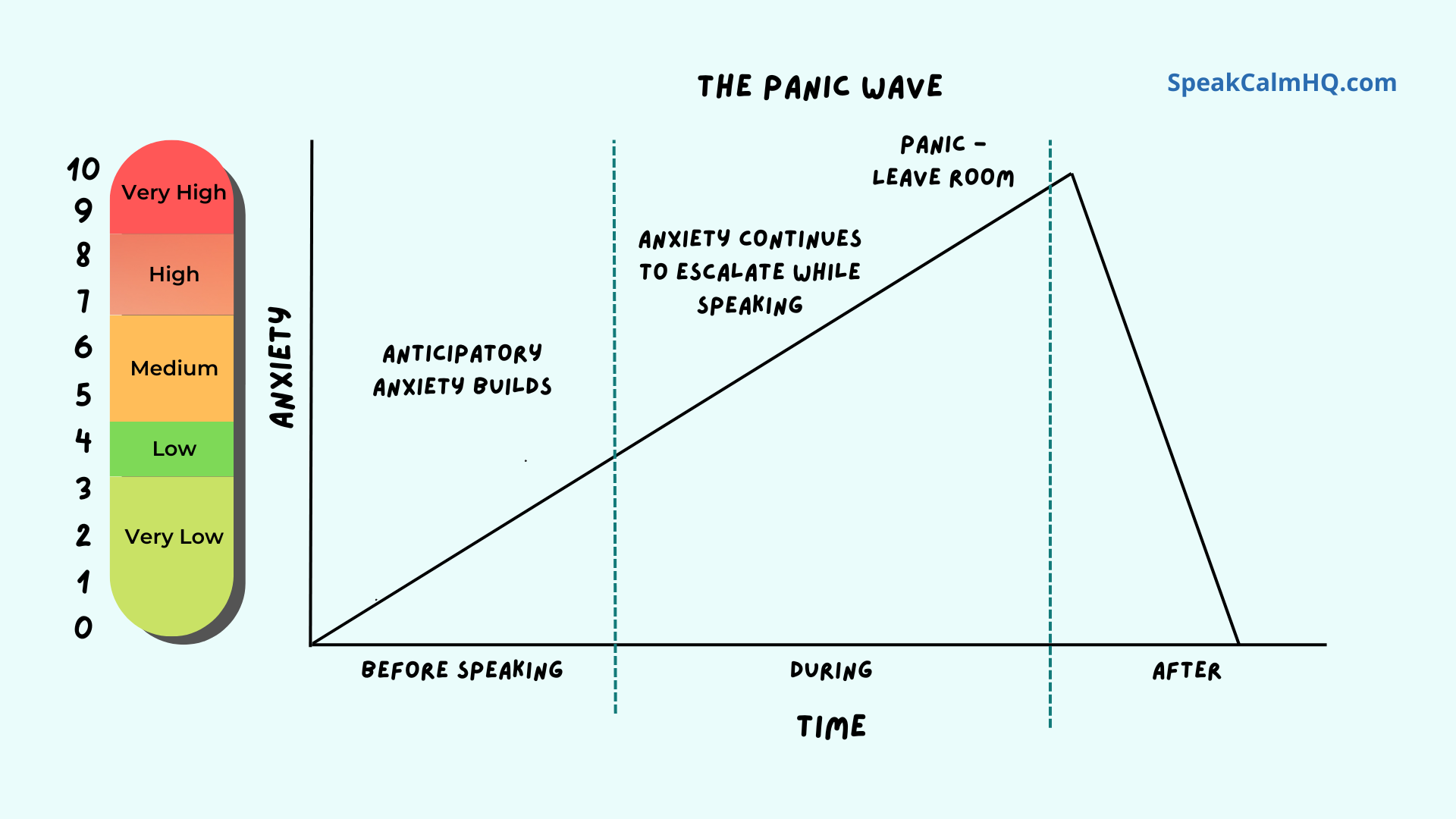
The HEART Goal: Keep yourself on the normal anxiety curve, preventing escalation into panic territory. Each successful navigation builds confidence and rewires your fear response.
The 5 HEART Steps
Step 1: Head Off Second Fear
At the first contact with anxiety (which could be weeks or months before a speaking event), become aware of catastrophic “what if” scenarios playing in your head. This is second fear—the fear of the fear itself.
What to do:
- Notice your catastrophic self-talk
- Recognize it as imagination, not reality
- Develop a realistic new script: “Just because something happened before doesn’t mean it has to happen now. I’ve been practicing and building positive memories. I’ve done this successfully before.”
- Use safe practice environments and visualization to create new positive memory associations
- Use safe practice environments to practice these techniques. You’re not practicing public speaking per se, you’re practicing applying these new MAP/HEART techniques while speaking.
Step 2: Eye On The Ball
Redirect your focus outward rather than inward. Anxiety thrives when we hyper-focus on internal symptoms (heartbeat, sweating, trembling)—and on how we’re coming across to others, with a harsh internal monologue running on a loop in our heads. Redirect your attention outward to your message.
What to do:
- Shift attention to your message and what your audience needs
- Focus on the environment—visual cues, friendly faces, room details
- Engage with content rather than monitoring symptoms
- Ask yourself: “What do they need to understand?” instead of “How am I appearing?”
Step 3: Allow
Let the first wave of anxiety (first fear) rise without fighting it. Resistance and attempts to suppress anxiety actually increase panic.
What to do:
- Accept the anxiety as temporary and manageable
- Don’t try to force it away or control every symptom
- Tell your nervous system: “This is okay. This is temporary.”
- This acceptance is the beginning of retraining your fear response
Step 4: Ride the Wave
Anxiety naturally peaks and drops if you allow it to run its course. Picture yourself surfing—you don’t fight the water, you ride it.
What to do:
- Stay in the situation long enough to see anxiety decrease
- Don’t escape early—this teaches your brain the situation is genuinely dangerous
- Trust that the wave will crest and fall naturally
- Each time you ride it out, you weaken the panic response
Step 5: Take the Win
Once the wave has passed, celebrate your success. This step is crucial for rewiring fear memories.
What to do:
- Acknowledge the victory—no matter how small
- Give yourself genuine credit for staying present
- Tell yourself: “I did it. The anxiety came and went, and I’m okay.”
- Your brain needs these wins to transform trauma memories into triumph memories
- Over time, wins stack and panic weakens permanently
Why HEART Works: This protocol was designed specifically for public speaking anxiety and panic, not just general stress management. By following these steps, you stay on the normal anxiety curve, gently exposing your nervous system without tipping into panic. Each success—even slight—reshapes your fear memory, making public speaking safe again.
Getting Started: Your Action Plan
Transforming your relationship with public speaking doesn’t happen overnight, but with the right approach, you can see rapid improvements. Here’s how to begin:
Week 1-2: Foundation Building
- Learn the MAP System framework: Understand the three pillars and how they work together
- Practice HEART steps: Start applying them in safe practice groups
- Identify your anxiety patterns: When does it spike? What are telling yourself before it spikes?
- Begin mindset reframing: Challenge your beliefs about anxiety, success, the audience, the situation, and your capabilities
Week 3-4: Safe Practice Begins
- Join an anxiety-specific practice environment: Not Toastmasters—a group designed for managing fear. Use safe practice clubs as stepping stones to work up to Toastmasters.
- Start with 10-second responses: Build gradually from ultra-short contributions
- Track your anxiety levels: Notice when you stay in the 4-6 range versus escalating to panic
- Celebrate small wins: Give your brain the positive reinforcement it needs
Months 2-12: Building Your Database
- Practice 3-5 times weekly: Consistency is essential for neural rewiring
- Gradually increase difficulty: Longer responses, more complex topics, larger audiences. We can do this in practice clubs and we can simulate larger audiences.
- Accumulate 50+ positive experiences: Each one weakens the old fear associations
- Apply skills in real situations: Meetings, presentations, social events
- Continue HEART application: It becomes automatic with repetition
Ready to Transform Your Speaking Anxiety?
The MAP System and HEART Protocol aren’t just theory—they’re proven tools that have helped thousands of people reclaim their voice and confidence.
Join our Practice Clubs for safe, supportive environments where you can apply these techniques with others who understand exactly what you’re experiencing.
Take the Masterclass “The MAP System: Your Tactical Toolkit for Speaking Anixety and Panic” for an in-depth guide to the MAP-HEART anxiety techniques.
Common Questions About Public Speaking Anxiety
Q: Will I ever feel 100% calm when speaking?
A: Not all the time—and that’s okay! Even experienced speakers feel some nervousness. The goal isn’t zero anxiety; it’s keeping anxiety in the manageable 4-6 range after the peak where you can function effectively and communicate your message clearly.
Q: How long does it take to see improvement?
A: Many people notice changes within the first few weeks of applying MAP and HEART techniques. Significant, lasting transformation typically occurs over 6-12 months of consistent practice (3-5 times weekly) and accumulating 50+ positive speaking experiences.
Q: What if I’ve tried everything and nothing works?
A: Most traditional approaches fail because they don’t address the root causes or provide safe exposure opportunities. The MAP System is different because it combines mindset work, activation control, and strategic practice—all three are necessary for lasting change. Mind, Body, Practice.
Q: Can medication help?
A: Some people find medications helpful for managing severe symptoms initially, but they don’t rewire the fear response. The MAP System teaches you to retrain your brain permanently, so you’re not dependent on medication long-term. You can use medication as training wheels while you’re desensitizing and improving. Always consult with a healthcare provider about medication decisions.
Q: Is this the same as general anxiety treatment?
A: While the MAP System incorporates proven anxiety management principles, it’s specifically designed for public speaking and performance anxiety. The HEART Protocol, Practice Smart framework, and communication-focused Mindset Shifts are tailored to the unique challenges of speaking situations.
The Bottom Line
Public speaking anxiety is a genuine, physiological condition—not a character flaw or sign of weakness. Your brain has learned to perceive speaking situations as dangerous, triggering intense fear responses. But just as this fear was learned, it can be unlearned.
The MAP System provides a comprehensive, science-backed roadmap:
- Mindset Shifts change how you interpret anxiety, success, the audience, the situation and your own capabilities
- Activation Control gives you tactical tools (like HEART) to manage symptoms in real-time
- Practice Smart ensures you build positive memories through safe, graduated exposure
With consistent application over 6-12 months, you can transform from someone who avoids speaking at all costs to someone who can contribute confidently in meetings, presentations, and social situations—even with some nervousness present.
Your anxiety doesn’t define you. With the right approach, support, and consistent practice, you can reclaim your voice and achieve your communication goals.