
Is Public Speaking Anxiety a Disorder?
You dread presentations. Team meetings make your heart race. The thought of speaking in front of others triggers panic. At some point, you’ve probably wondered: is this normal nervousness, or do I have an actual disorder?
It’s a fair question—and the answer matters, because understanding what you’re dealing with helps you find the right approach to addressing it.
The Clinical Picture
Public speaking anxiety exists on a spectrum. At one end is normal nervousness—the butterflies most people feel before presenting. At the other end is what clinicians call Social Anxiety Disorder (SAD), specifically the “performance only” subtype.
According to the Diagnostic and Statistical Manual of Mental Disorders, Fifth Edition, Text Revision (DSM-5-TR) (the diagnostic manual used by mental health professionals), Social Anxiety Disorder involves marked fear or anxiety about social situations where you might be scrutinized by others. For some people, this applies broadly to many social situations. For others—the “performance only” specifier—it’s limited specifically to speaking or performing in front of others.
When Does It Cross Into “Disorder” Territory?
The key criteria that distinguish a disorder from normal nervousness are intensity, avoidance, and impairment.
Intensity: The fear is out of proportion to the actual threat. You’re not just nervous—you’re terrified. The anxiety might include panic attacks, severe physical symptoms, or a sense that something catastrophic will happen.
Avoidance: You go to significant lengths to avoid speaking situations. You turn down promotions, skip important meetings, call in sick on presentation days, or restructure your life to minimize speaking requirements.
Impairment: The anxiety significantly interferes with your work, relationships, or goals. Your career is limited. Your quality of life suffers. You’re not living the life you want because of this fear.
Duration: The fear has persisted for six months or more.
If you’re experiencing all of these, you may meet criteria for Social Anxiety Disorder (performance only). But here’s the important part: whether or not you meet clinical criteria, the strategies for improvement are largely the same.
Why the Label Matters (and Doesn’t)
Why It Might Matter
Validation: A diagnosis can help you understand that what you’re experiencing is real, recognized, and not a character flaw.
Treatment is different: High-to-severe anxiety requires a different treatment than low-to-moderate anxiety. Once you’ve had a panic attack, that’s a trauma, and that experience gets seared on your brain. That requires a specific treatment.
Treatment access: A formal diagnosis may help you access therapy, medication, or workplace accommodations. Insurance may cover the costs.
Self-compassion: Understanding you have a condition (not a personal failing) can reduce shame and self-blame.
Why It Might Not Matter
Labels can limit: Some people find that a diagnosis makes them feel more “stuck” or permanent. In reality, public speaking anxiety is highly treatable regardless of severity.
What the Research Says About Treatment
Here’s encouraging news: public speaking anxiety—even at disorder level—responds well to treatment. Cognitive Behavioral Therapy (CBT) has the strongest evidence base. It works by changing both the thoughts (cognitive restructuring) and behaviors (gradual exposure) that maintain the anxiety.
Exposure therapy, specifically systematic desensitization, is particularly effective. This involves gradually facing speaking situations in a controlled way, starting with less threatening scenarios and building up. Each successful experience teaches your brain that speaking isn’t actually dangerous.
For some people, medication (typically beta-blockers) can be a helpful addition, particularly while building skills and confidence through therapy.
You’re Not Alone—Or Broken
Public speaking anxiety is common. Approximately 66% of the US population say they are afraid of public speaking (slightly afraid, afraid, very afraid). About 12% of the US population say they are very afraid of public speaking.
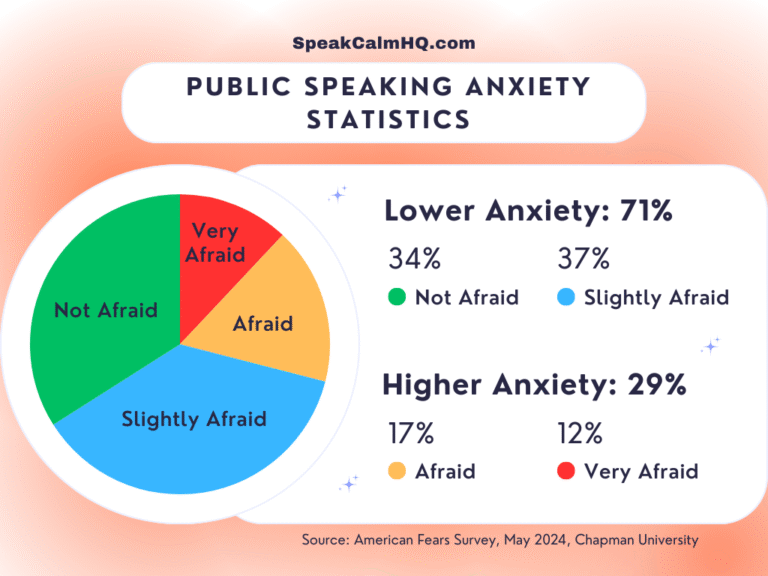
You’re not alone in this struggle. And crucially, you’re not broken. Your brain has learned to associate public speaking with danger—probably through some combination of past negative experiences and learning. What has been learned can be unlearned.
What To Do Next
If you’re wondering whether your public speaking anxiety is “bad enough” to do something about, here’s a simple test: Is it limiting your life? Is it causing you distress? Is it preventing you from doing things you want to do?
If yes, it’s worth addressing—regardless of whether it meets clinical criteria for a “disorder.” You don’t need a formal diagnosis to benefit from strategies like cognitive restructuring, gradual exposure, and skills practice.
You can also take the free public speaking anxiety test to see if your anxiety is low, moderate or high. And get recommendations specific to your level of anxiety.
If you have moderate-to-high-to-severe anxiety, the path forward is the same: understand what’s happening in your brain and body, make key mindset shifts, learn techniques for managing symptoms, and gradually build positive experiences through safe practice. The Complete MAP System course gives you the road map for overcoming public speaking anxiety and panic. The course will give you new tools so you can go into speaking situations differently and get different results.
Reference
American Psychiatric Association. (2022). Diagnostic and Statistical Manual of Mental Disorders (5th ed., text rev.). American Psychiatric Association Publishing.
© SpeakCalmHQ MAP System for Public Speaking Anxiety. All Rights Reserved.